
The Art of Getting Your Message Across
- Wendy Marshall
- May 25, 2023
- 5 min read
Updated: Jul 19, 2023
You say 'tomarto', I say tomayto, and there is a saying 'six of one and half a dozen of the other'. The fact is that both examples are saying the same thing, and it is all in the communication!
We all have interpretations of the information we are delivering and receiving, which can be different! And that's OK because how we communicate and get our messages across will always come down to our style of delivering the information. However, when it comes to the other person receiving the message, how they do this effectively will be impacted by their style. What do I mean by this?

To communicate effectively, the message or messages must be delivered and interpreted as intended by both the giver and receiver. This can be a challenge for many people, as many are unaware of their own behavioural or learning style, let alone other people; that would be too much to expect, wouldn't it? Well, not really, as we can all learn our style and when you know your style, you understand more about how to identify other people's styles. Maybe I am jumping in too quickly, so let's pull back a bit.
“To effectively communicate, we must realise that we are all different in the way we perceive the world and use this understanding as a guide to our communication with others”. Tony Robbins
When communicating, each person's role is to take responsibility for how they articulate information and listen to the information. So when it is a 2-way communication, we all have two roles, talking and listening. Many people forget the listening part and focus on speaking, often listening to respond instead of listening to understand. Remember the adage; we have two ears and one mouth to be used in that ratio. In other words, we benefit from listening more than we talk. Tony Robbins, one of the world's best life and wealth coaches, states, “To effectively communicate, we must realise that we are all different in the way we perceive the world and use this understanding as a guide to our communication with others”. Our perception of the world is influenced by the way we see the world, which is different for everyone.
While there may be some commonalities in many cases, essentially, as human beings, we are all different. Our unique behavioural and learning styles or combination of styles will significantly influence how we communicate with others and how we want to be communicated to.
"Our unique human endowments lift us above the animal world. The extent to which we exercise and develop these endowments empower us to fulfil our uniquely human potential". Stephen R. Covey
The good news is that there is an easy way to effectively present information to others regardless of your own unique behavioural or learning style. Your style will influence the attractiveness of your delivery; however, the presented information can be delivered in a format that will enable just about anyone willing to listen or read your message to understand it. In his book, 'The 7 Habits of Highly Effective People', Stephen R. Covey highlights that "our unique human endowments lift us above the animal world. The extent to which we exercise and develop these endowments empower us to fulfil our uniquely human potential".
The 4MAT model was initially developed by Bernice McCarthy in 1980. It is based on research from many fields but mainly synthesises findings from the areas of learning styles and right and left brain dominance. As a professional development tool, it provides a framework for assessing the quality of any learning experience. The 4MAT model uses right and left mode strategies with four distinct phases of the learning cycle: experiencing, conceptualising, applying, and refining.
To communicate in a way that enables you to deliver information as clearly and accurately as possible and then have it received or interpreted in the way you intended, the 4MAT model provides a proven framework that connects with all people’s learning styles.
Technically there are four steps to the 4MAT model, and in using this model to communicate effectively, there is value in adding an introductory step, so it becomes five steps to getting your message across. Whether you are communicating in written form or verbal, this framework is a powerful tool to use to construct your communications in a way that has a logical flow that most people will engage in because it embraces all the phases of learning styles.
Step 1 - State the topic.
This is your brief introduction about what the topic being communicated is. This could be a clear subject line and a brief introduction at the start of an email or a letter. In a verbal conversation or presentation, introduce yourself and the topic you will be discussing.
Step 2 - Outline the importance and benefit of raising the topic.
This is making a statement about why this topic being communicated is essential and, where possible or relevant, backing up this importance with a statistic or specific benefits from having the conversation. It can also be powerful to add contrasting views or a story to reinforce, which is particularly impactful when presenting. The why is the meaning behind the communication.
Step 3 - Clearly state what needs to be addressed or what is involved.
This section clarifies the topic, what needs to be understood, and what is involved in responding or acting on the issue. The what is explaining the concepts to inform.
Step 4 - State the steps involved in addressing the issue or topic.
This is about how to act and address the topic or point being communicated. Explain each step logically, stating why it matters and what is involved. This is aimed at giving the receiver of the message clarity on what they can do or need to do to respond to the communication if they are responsible for doing so or wish to for their benefit. The how introduces the skills and knowledge needed to act.
Step 5 - Summarise the communication.
This step is known as what if, summarising what you have communicated and inviting questions or comments on the message. This what if is about the adaptation of the message being communicated.
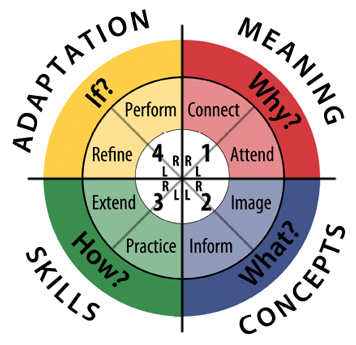
Image from www.4mat4learning.com.au
George Bernard Shaw highlighted, "The single biggest problem in communication is the illusion that it has taken place." It is so easy to believe that because words have been said or written and delivered, communication has taken place...however, has it been effective? This research-based model will make your communications effective for all, open to listening and receiving your messages. It provides a proven framework to construct written or verbally presented messages to relate to all learning and behavioural styles. By using this framework consistently when communicating, you will, with practice, develop a solid ability to communicate effectively and get your message across with impact.
Book a Free Strategy Session with a lead coach at Leaders Network if you want support to understand your behavioural energy style and how it influences your communication.

Comments